

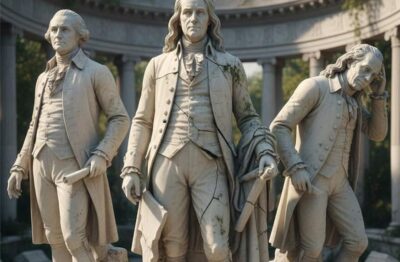
Foundational democratic principles were tested throughout 2025, challenged by leaders who substituted performance for governance and grievance for responsibility.
By

Democracy rarely falters in a single moment. More often, it weakens gradually—through distortions of truth, quiet erosions of rights, and the steady normalization of power exercised without restraint.
The columns collected here were written at different points throughout 2025, in response to events both national and local. Read together, they reflect a year in which foundational democratic principles were tested not by sudden crisis, but by habit—by the willingness of leaders to substitute performance for governance, loyalty for honesty, and grievance for responsibility.
Each piece examines a different pressure point: the misuse of history, the corrosion of shared reality, the unfinished work of civil rights, the necessity of resistance when power refuses accountability, and the enduring value of pragmatic leadership over political spectacle. Individually, they address specific moments. Collectively, they raise a broader question about what happens when truth becomes inconvenient, and institutions are treated as obstacles rather than safeguards.
These essays are not offered as predictions or prescriptions, but as an invitation—to look clearly at the forces shaping public life, and to consider what citizenship requires when democracy can no longer be taken for granted.
Wrapped in flag and cross, history’s warning is knocking at America’s door
This column examines the persistent pull of power, fear, and grievance in human affairs, situating today’s political divisions within a long historical continuum. Drawing on ancient history, American experience, and current legislation in Alabama, it connects global patterns of democratic erosion to local efforts to mandate patriotism and piety. The piece argues that history repeats not because it is forgotten, but because leaders and citizens alike convince themselves its lessons no longer apply—and that democracy endures only when people choose restraint and courage over control.
Trapped in a hall of mirrors: How lies distort our reality
This column explores how misinformation has evolved from isolated falsehoods into a governing strategy that undermines shared reality itself. Drawing on historical examples of propaganda and modern disinformation campaigns, it argues that democracy cannot function without a common understanding of truth. The piece warns that when institutions tasked with protecting facts are discredited or punished, the damage extends beyond politics—threatening the basic capacity of a society to reason together.
The battle for civil rights didn’t end in Selma—it still rages on
This column examines the unfinished struggle for voting rights and racial justice, arguing that the violence faced by marchers in Selma never disappeared—it evolved into legal, procedural, and political barriers designed to suppress participation. Drawing on the legacy of Bloody Sunday and the Voting Rights Act, it connects historic progress to modern voter suppression, gerrymandering, and backlash politics. The piece contends that civil rights are never permanently secured, and that each generation is tested by whether it will defend what earlier ones bled to win.