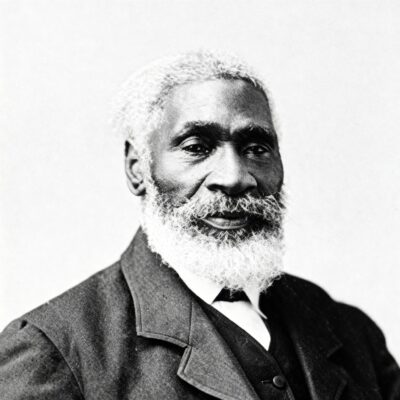

He Was Born Enslaved — And His Life Helped Break the Chains of Millions
His name was Josiah Henson.
And long before his story changed history, it broke a child.
A Childhood Stolen Before It Began
Maryland. 1794.
A plantation where childhood was a luxury, enslaved children never knew.
Josiah was five years old.
Five.
Old enough to remember.
Too young to understand why cruelty had no limit.
He watched an overseer beat his mother so violently that her face was shattered. Bones broken. Features ruined. The woman who had smiled at him no longer could—not the same way, not ever again.
And the most horrifying truth?
This wasn’t an extraordinary act of evil.
This was normal.
This was routine.
This was Tuesday under slavery.
A little boy stood there, powerless, learning the first brutal lesson of his life:
Love offered no protection. Humanity earned no mercy.
Growing Strong in a World Designed to Break You
Josiah grew into a man inside that nightmare.
Strong. Reliable. Trusted.
So trusted, in fact, that his enslaver allowed him to preach on Sundays—allowed him to speak to other enslaved people about faith, obedience, and endurance.
But trust under slavery was never kindness.
It was leverage.
At forty-one years old, after decades of loyalty, Josiah learned the truth:
He was going to be sold south.
Sold away from his wife.
Sold away from his four children.
Sold away from every fragile thing he loved.
In slavery, families were temporary.
Children were assets.
Love had a price tag.
That was the moment something inside him hardened into certainty.
The Night He Chose Freedom Over Fear
Josiah didn’t explode in rage.
He became clear.
He would not let his children watch their mother being beaten.
He would not let them be sold like animals.
He would not pass on the same terror he had inherited.
So he made the most dangerous decision an enslaved man could make.
He chose to run.
In 1830, under the cover of darkness, Josiah gathered his wife and four children—including a baby who couldn’t walk.
No map.
No money.
No safety.
Just faith and fear and love.
They walked through forests that swallowed sound.
They crossed rivers that could have killed them.
They hid from bounty hunters who hunted human beings for profit.
The baby cried from hunger.
Their feet bled.
Their bodies shook with exhaustion.
Every step forward risked capture, torture, and death.
But behind them was certain slavery.
Ahead was possible freedom.
And possible freedom was worth everything.
The Ground That Did Not Own Him
When they reached Ontario, something changed.
British law declared that no human being could own another.
Josiah fell to his knees and kissed the ground.
Free ground.
Ground where his children could grow up as people—not property.
Where reading was not a crime.
Where families stayed together.
Freedom didn’t make him disappear.
It made him rise.
From Survivor to Liberator
Josiah became a minister.
A leader.
A builder.
He helped establish the Dawn Settlement—a refuge for other escaped slaves finding their way north. He guided hundreds to safety. He fed them. Housed them. Reminded them they were human again.
And he told the truth.
He wrote his autobiography—refusing to let the world forget what slavery really was.
And someone listened.
The Story That Lit a Nation on Fire
A writer named Harriet Beecher Stowe encountered testimonies like Josiah’s.
She read about a five-year-old boy watching his mother being destroyed.
About a father carrying a baby through the wilderness, unsure if dawn would come.
About faith that survived systematic cruelty.
She couldn’t let it go.
So she wrote a novel.
She called it Uncle Tom’s Cabin.
And America cracked open.
The book sold 300,000 copies in its first year. Families read it aloud. Churches preached from it. Dinner tables erupted into arguments.
For the first time, millions saw enslaved people as mothers, fathers, children—not abstractions.
The South burned the book.
Abolitionists spread it everywhere.
And when Abraham Lincoln met Stowe during the Civil War, he reportedly said:
“So you’re the little woman who wrote the book that started this great war.”
But the fire began earlier.
It began with men like Josiah Henson—brave enough to tell the truth.
A Life That Outlived Chains
Josiah Henson lived to be 94.
He saw slavery end.
He saw his children and grandchildren grow up free.
He helped hundreds do the same.
He never led an army.
He never held office.
He never wrote fiction.
But his life became a weapon against injustice.
Why His Story Still Matters
Sometimes the most revolutionary act is telling the truth.
Truth about pain.
Truth about survival.
Truth about dignity.
Josiah Henson was five years old when he learned the world was broken.
He spent the rest of his life helping to fix it—
one escape,
one family,
one story at a time.
And the world is freer because he refused to stay silent.