

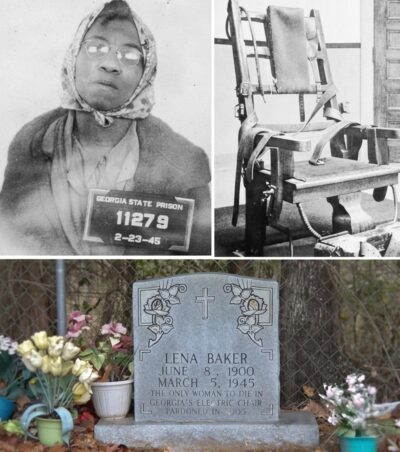
She defended herself, and the system killed her for it.
The Tragic Story of Lena Baker
A Stark Reminder of Jim Crow Injustice.
The year was 1944. Cuthbert, Georgia, a place where the law was white, and judgment came before truth. Lena Baker was a 44-year-old mother, a Black woman born into a world that refused to see her humanity. She worked as a maid, not by choice, but by survival. Her employer, Ernest Knight, a white man, kept her in what can only be called captivity. He controlled her life. He threatened her. He abused her. And the community looked the other way — because harming a Black woman in the Jim Crow South wasn’t considered a crime.
One night, the violence finally reached its breaking point. Knight attacked her. Lena fought back.
A struggle. A moment of terror. A single gunshot. Knight was dead, and Lena Baker was suddenly trapped between survival and the law that never protected her. She pleaded self-defense. She pleaded fear. She pleaded truth. But in that courtroom sat an all-white, all-male jury, determined to punish the Black woman who dared resist a white man’s power.
It took them less than a day to decide her fate. Death. By electric chair. Lena Baker had no wealth,
no resources, no voice the court cared to hear. On March 5, 1945, she was executed, and the only woman ever put to death by Georgia’s electric chair. And with the pull of a switch, the State tried to erase her. But history remembers.
In 2005, the Georgia Board of Pardons and Paroles finally admitted what the world already knew: Lena Baker never should have been killed. The system failed her because it was built to fail her. Her name now stands as more than a tragedy. It stands as a warning: When justice is selective, when the courtroom bows to racism and misogyny, when the oppressed have no right to defend themselves, the law becomes another weapon. Lena Baker did not die because she was guilty. She died because she was Black and she dared to survive