

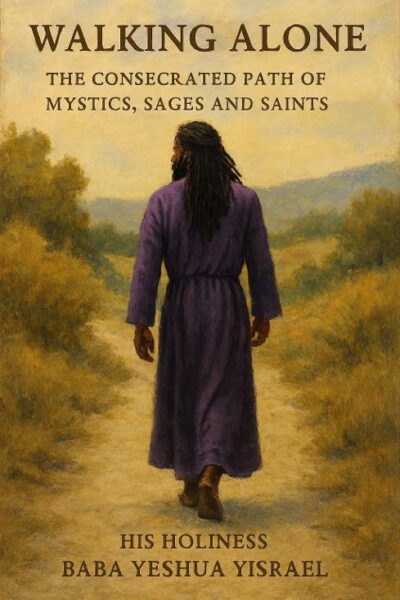
 For the past forty-five years, I have been set apart, called into the interior life of prayer, Eucharist, and study of liturgical Hebrew. I visited Holy shrines, the church of the holy sepulcher and the Kotel or Temple Wall in Jerusalem. During the initial phase of set apartness, I inappropriately characterized the experience as loneliness. However, with spiritual growth and maturation, my perspective evolved. I began to understand and deeply appreciate the critical role of aloneness and solitude in my life. This article reframes the solitary path of mystics, sages, and saints—not as abandonment, not as loneliness, but as Kadosh: set‑apartness, consecration, alignment with HaShem. Mystics across traditions share a paradox: they often walk alone, yet they are never abandoned. Their solitude is not a wound but a consecration—a setting apart for the sake of clarity, fidelity, and communion with the Holy One. In Hebrew, this state is kadosh: separated not by rejection, but by purpose.
- The Necessity of Solitude in the Spiritual Vocation. Those who are called to deep interior work inevitably find themselves stepping outside the rhythms of ordinary social life. Not because they disdain others, and not because they are incapable of belonging, but because:
- Interior silence requires spaciousness.
- Revelation requires listening.
- Alignment requires undistracted fidelity.
The mystic’s solitude is the workshop where the soul is shaped, the sanctuary where the heart is purified, and the chamber where the Presence becomes audible.
- Consecration, Not Loneliness. Loneliness is the ache of absence. Consecration is the fullness of Presence. The mystic does not walk alone because no one walks with them; they walk alone because the One walks with them in a way that others cannot. Their solitude is not empty; it is inhabited. It is not a void; it is a vessel. To be kadosh is to be set apart for a purpose, marked by the Holy, claimed by HaShem for a work that cannot be done in the noise of the crowd.
- The Pattern of the Ancients
Every tradition bears witness to this pattern:
- Moses ascends Sinai alone.
- Elijah hears the still small voice only after withdrawing to the cave.
- Yeshua goes into the wilderness for forty days.
- The prophets receive their oracles in the margins, not the marketplaces.
- The desert fathers and mothers flee the cities to preserve the flame of prayer.
- Rabbi Nachman and Hasidic masters retreat into forests to speak heart-to-Heart with God. Their solitude is not an escape from humanity but a deeper service to it. They return bearing clarity, blessing, and transmission.
- The Interior Sanctuary
The mystic’s solitude is not merely physical. It is an interior stance; a sanctuary carried within the chest.
In this sanctuary:
- The heart becomes an altar.
- Breath becomes prayer.
- Silence becomes revelation.
- Presence becomes teacher.
This interior sanctuary is where the mystic learns to distinguish the voice of the Holy from the noise of the world. It is where the soul becomes attuned to the subtle movements of grace.
- Why the Path Cannot Be Crowded
The mystical path demands a kind of attentiveness that cannot be shared in its deepest moments. Others may accompany the mystic for stretches of the journey, but the decisive thresholds—the moments of encounter, surrender, purification, and illumination—are crossed alone. Not because the mystic is abandoned, but because:
- No one else can hear what is meant for them.
- No one else can carry their covenant.
- No one else can walk their particular alignment with HaShem. Consecration is always personal before it becomes communal.
- The Gift of Being Set Apart
To be set apart is not to be superior; it is to be responsible. It is to carry a resonance that must be protected. It is to live with a fidelity that cannot be diluted. It is to stand in a field of Presence that requires integrity, silence, and interior spaciousness. The mystic’s solitude is therefore not a punishment but a privilege—a sacred trust.
- Returning as a Blessing
Though mystics walk alone, they do not remain isolated. Their consecration equips them to return to the world as:
- bearers of clarity,
- transmitters of peace,
- witnesses of the Holy,
- and vessels of compassion.
Their solitude becomes a gift to others because it has purified their seeing and softened their heart.
Dr. Yisrael teaches an introductory Hebrew reading course. Interested? Contact: Babayshua@gmail.com