

Black Veterans Have Always Fought Two Wars, Battling the Enemy Abroad and Prejudice at Home

by
In the summer of 1946, George Dorsey, a World War II veteran who had served tours in North Africa and the Pacific theater, was easing back into post-war life after five years in the Army. He was working as a sharecropper in Walton County, Georgia, after returning home, and living with his wife, Mae.
On July 25, just 10 months after Dorsey came home, a mob of white men swarmed a car that contained Dorsey and Mae, as well as Dorsey’s sister and brother-in-law. Enraged by a report that Dorsey’s brother-in-law, Roger Malcom, had stabbed a white man, the mob eventually pulled both couples from the car, beat them, and shot them more than 60 times. Although people witnessed the lynching and although the men in the mob didn’t hide their faces, the police made no arrests. The crime is still officially unsolved today.

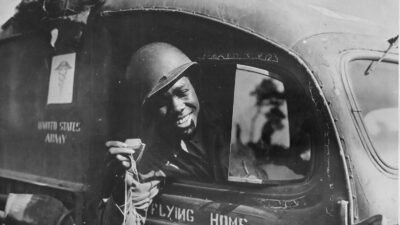
In the years following World War II, in which well over a million Black Americans joined the fight against fascists, troops returned home to a nation that, in many ways, was still decidedly antidemocratic. Jim Crow laws and discrimination, both sanctioned and unofficial, shaped the reality of post-war life for many Black veterans. Just as had happened upon their return home from World War I, American servicemen and sometimes women came back from World War II to bigotry, exclusion, and overt racial violence—precisely because they had served their country.
“They were a threat because they carried themselves with pride,” says Matthew Delmont, a history professor at Dartmouth who has written about Black Americans in World War II. “This is true during the war and after the war—just the sight of a Black person in a military uniform was upsetting to a lot of white Americans.”
Although Black Americans have fought in every conflict since the Revolutionary War, the breadth and dedication of their service, and their distinct experiences in uniform and upon returning home, are often omitted from or minimized in historical narratives of military service—part of a legacy of discrimination that continues today.
“We have to start with the fact that when America thinks about a veteran, they often think about a white man,” says Richard Brookshire, the co-founder of the Black Veterans Project, which works to elevate the stories of Black veterans and servicemembers. “There is an erasure, an erasure to the historical harms and the present-day harms that continue for Black people who serve.”

Historians regard the lynching of George Dorsey, his wife, and Roger and Dorothy Malcom—often known as the Moore’s Ford lynchings for the place where they died—as the last mass lynching in American history. The Moore’s Ford lynchings were not the last lynchings in the country, nor were they the last lynchings of a veteran. But their extraordinary brutality, the lack of accountability even after multiple investigations, and that they involved a veteran so recently returned from war ignited a national backlash against the racial violence so many Black Americans faced. This ultimately helped to pave the way to the civil rights movement—a movement that Black veterans, shaped by their experiences in uniform, pushed forward.
“Black Americans have served in every military conflict the United States has ever been a part of, going back to the American Revolution, Civil War, World War I, World War II,” Delmont says. “But that service has always meant a different thing than it’s meant to most white service members.
“Theirs was a critical form of patriotism. They wanted to really fight to make America a country that was worth fighting for.”
We Knew That Not to Be True
In his 1917 speech to Congress asking the United States to enter World War I, President Woodrow Wilson argued that “the world must be made safe for democracy.”
“We are but one of the champions of the rights of mankind,” he declared. “We shall be satisfied when those rights have been made as secure as the faith and the freedom of nations can make them.”
But in war—as on the home front, where Wilson’s administration aggressively pursued segregation in the federal government, as well as the removal of Black government officials—the rights of mankind were not equally extended. More than 350,000 Black sailors and soldiers signed up or were drafted to serve in World War I. But they faced discrimination in the ranks: pushed into jobs white soldiers didn’t want and issued inferior gear and equipment. White service members sometimes refused to salute Black officers, who were often barred from officers’ clubs and dining halls, and at times Black soldiers had to eat and sleep outside. Some Black soldiers were even issued decades-old Civil War uniforms.

Still, within the Black community, many saw benefit in joining. Intellectual leaders like W.E.B. Du Bois initially encouraged Black citizens to join the war effort, both out of a sense of patriotism and in hopes that proving patriotism would open doors to greater opportunity.
“He encouraged Black people to serve because it would be a pathway to equal citizenship,” Brookshire says. “When folks got back from World War I, we knew that not to be true.”
In the summer of 1919, following the end of the war the previous fall, the country was swept up in a spasm of horrific nation-wide racial violence, which came to be known as the Red Summer. Race riots broke out in Chicago, Washington, and many other cities. White mobs lynched dozens of Black Americans. At the end of September, in an anti-Black massacre in rural Arkansas, where Black sharecroppers had attempted to negotiate pay and cotton prices, roaming mobs of armed white men killed more than 100 Black citizens.
Returning veterans were not immune from this violence. Rather, mobs often targeted Black soldiers and sailors who had served in World War I because they had served.
In 1917, Sen. James Vardaman of Mississippi warned against allowing Black Americans to join the military, arguing that it would inflame the fight for equal rights.
“[I]nflate his untutored soul with military airs,” he said in a speech on the Senate floor, adding, “It is but a short step to the conclusion that his political rights must be respected.”
It was a sentiment that echoed in communities across the South, where many white citizens felt compelled to prove those rights would not be respected. In Kentucky, just a month after the end of the war, a recently discharged Army private named Charles Lewis was arrested while wearing his uniform after a white sheriff accused him, without evidence, of robbery. Upon hearing of his arrest, a crowd of nearly 100 men broke into the jail where Lewis was held and murdered him by hanging him from a tree.
Likewise, in Texas, another recently returned veteran, Ely Green, was beaten by four white police officers for wearing his uniform in public. During the summer of 1919, Lucius McCarty, a Black veteran in Louisiana, was shot more than 1,000 times after he was accused of trying to assault a white woman. In Arkansas, a Black veteran named Frank Livingston was burned alive after a white mob tortured him into confessing to murdering a white couple.

Active duty sailors and soldiers were also targeted. In 1917, the Black 3rd Battalion, 24th Infantry Regiment was sent to Houston, where police officers and local citizens harassed them. The abuse eventually led to an armed riot in which four Black soldiers and 16 white civilians died. Nineteen Black soldiers were later sentenced to death and executed.
In May 1919, hundreds of white Navy sailors stormed into a hotel in New London, Connecticut, where Black sailors from the nearby naval base often congregated, pulling their fellow sailors outside and beating them.
“What does that say to African Americans, let alone any other group, that on one hand, you desperately need us—you tell us it’s our responsibility, that we are American citizens. We need to step up to the plate,” says Charissa Threat, a history professor at Chapman University who writes about gender and race in veterans’ history. “We want to step up to the plate. But we are met with both discrimination while serving, violence while serving, and certainly [when] coming home.”
They Will Not Send Their Sons to War Again
In the years between World War I and World War II, the organizing power of Black activists expanded as anger grew over persistent inequality and the waves of racial violence. Membership in the NAACP, founded in 1909, swelled from 9,000 in 1917 to more than 90,000 just two years later. The organization and Black activists pursued legal cases challenging discrimination and segregation, and worked to document the extent of the violence Black Americans faced. Professional organizations for Black workers excluded from white organizations also grew and fought for more equal working conditions.
As World War II loomed, so did the same questions about patriotism and equality Black soldiers and sailors in World War I faced.
“You have veterans who have served in World War I, who have done a lot of work during the 1920s and 1930s, and who are very vocal that they will not go or send their sons or their grandsons, in some cases, to war again, if something doesn’t change,” Threat says.
Black leaders pushed for greater equality and better treatment on the home front and in the military. Walter White, the executive secretary of the NAACP, and A. Philip Randolph, the president of the Brotherhood of Sleeping Car Porters, pressured the Roosevelt administration to end segregation and discrimination in the military branches—Black citizens were not allowed to join the Marine Corps until 1942—and the defense industry. Activist organizations sought, again, to connect a willingness to fight with the need for equal rights.
“They were not just talking about access to military service or improvements for Black servicemembers,” Threat says. “They were also talking about—how do we use military service to then leverage political change or social change as well?”
