

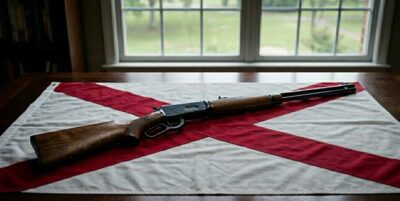
Gun suicides quietly killing older Alabama men at staggering rate — but some are doing something about it
Jason Smith remembers the moment when things started to change for him, just as he was flying home to Alabama from the funeral of a former Marine colleague.
It was April 2017. His friend, Master Sgt. John Drascula, a decorated 24-year veteran with tours in Somalia, Afghanistan, and Iraq, had died by suicide in late March.
“He had been sober for 15 years, but he relapsed when his mom and dad died within a month of each other,” Smith said.
It was yet another funeral of yet another service member who had taken his own life. Old bunkmates were reunited. Another of Smith’s friends, Eric Nelson, had died the year before from an ovedose, and his death came just two months before Smith’s own father died.
After that, Jason said, his drinking got progressively worse.
While at Drascula’s funeral, Smith spoke to another veteran. They talked of staying in touch so that something like this wouldn’t happen again.
Within 18 months, that man was dead too, by his own hand.
Smith, 49, remembers getting on the plane in North Carolina, once the funeral was over, and wanting his own life to end. The entire experience made him confront his own struggles with alcoholism and his emotional well-being – problems all too similar to those of the men departed.
Something, he understood, had to change. Provided the flight took him home.
“I hope this f*****g plane crashes,” he remembers thinking. “I don’t give a shit.”
It was a galvanizing moment for him.
“When I got off the plane, that’s when I did something,” he said.
Not long after, he began rehab. Now Smith is the director of Veterans Programs at Florida Springs Wellness and Recovery Center in Panama City, Fla., working with veterans dealing with the effects of substance abuse, post-traumatic stress, and other issues. He is also a coordinator for Safer Together, a program in Alabama focused on bringing down the number of people who die by suicide using firearms, a problem that observers agree has reached unconscionable levels.
By his own count, Smith, a 20-year Marine Corps, a veteran who served two tours in Iraq, has known personally at least eight people who have died by suicide.
‘The numbers…keep growing.’
Smith’s comrades weren’t over the age of 70, but their deaths highlight many of the problems older Americans are going through.
While suicide among young people gains the lion’s share of public attention, older Americans are dying at ever-increasing numbers by suicide using firearms. Since 2010, more than 66,000 people 70 or older, according to data from The Gun Violence Data Hub, an initiative of The Trace, a non-profit newsroom that covers gun violence in America.
Alabama has an elevated level of gun suicides among older adults. Over 15 years, from 2010 to 2024, according to the Centers for Disease Control, 1,467 older Alabama residents died by suicide involving a firearm.
Those numbers put Alabama among the top 15 states in the nation, with a rate of 18.1 suicides per 100,000 residents over the age of 70.
Dig deeper, and the results are more stark. In four counties – Dale, Elmore, Henry, and Jackson – the rate of gun suicides among older adults is higher than in any U.S. state. Those four counties are spread across Alabama – in the Wiregrass, the Black Belt, and the state’s northeast corner. They represent rural areas and suburban.
To put it even more starkly, gun suicides kill more Alabama men over the age of 70 than car crashes.
“The numbers for that era are unbelievable, and keep growing,” said Jeff Newton, a retired Air Force general who is a commissioner with the Alabama Department of Veterans Affairs.
Take veterans, for example, who also make up part of that demographic. According to the Veterans Administration, 6,398 veterans died by suicide in the U.S. in 2023, the latest year for which data is available. By contrast, more than 47,000 Americans took their own lives that year. Roughly 35 out of every 100,000 veterans die by suicide.
Alabama is home to about 400,000 veterans, or about 10 percent of the population. Yet they make up 18 percent of suicides. There were 139 veteran suicides in Alabama in 2023.
“In Alabama, 86% of veteran suicides involve firearms,” Smith said. “That’s more than the national average.”
Smith is a compact, well-built man whose two decades in the service are evident in his frame. At first glance, you might not expect any emotional display beyond a handshake or a deep laugh. But on one recent occasion when asked, his voice caught when thinking of the men he knew.
“Every time the phone rings, and I can see it’s someone I haven’t talked to in a year, I think, shit, here we go,” he said. “Every year, it seems there’s one or two. Suicide, overdose, or some tragic accident.
“There’s not a veteran who won’t tell you, they probably know between five and 10 people close to them who died by suicide,” he said. “That kind of statistic sounds crazy, but it’s real.”
One happened in Iraq during Smith’s first tour of duty, which began in 2007. In downtown Ramadi, an Army 1st Sgt. riding in a convoy got out of a truck on the main thoroughfare.
“He shot himself in front of everybody on the road,” he said.
Later at Camp Lejeune, N.C., in 2010, only minutes after Smith drove past an area on base, a man shot himself while running from MPs.
The May 2010 death of that man, Sgt. Thomas Begosy prompted calls for the U.S. military to take the problem of rising suicide rates among its members more seriously.
Among the men Smith has known over the years have been deaths by overdoses and car accidents that seemed deliberate. And there have been deaths by firearms.
Veterans, he said, are the kind of people who run into danger, not away from it. They have training and access to firearms. They have sometimes seen unspeakable things that are not easily shared with strangers or loved ones.
And what may seem like a snap judgment is often the result of days, months, even years of silent contemplation.
‘Not a right to bear arms conversation.’
Cheryl Dodson has been the executive director of the Alabama Suicide Prevention & Resources Coalition for eight years. It’s an issue that has touched her directly; Dodson was a friend of John B. McLemore, the Woodstock man who was profiled in the 2017 podcast “S-Town.” McLemore died by suicide in 2015.
Dodson regularly talks to groups about spotting the signs that someone may be thinking of ending his own life.
Three factors can make all the difference – feeling isolated, feeling like a burden and having firearms. You’ll notice the word “feeling” pops up in two of those reasons.
But the third is also important, she said.
“It’s not a ‘right to bear arms’ conversation,” she said. “It’s about mental health responsibility. If you ask someone to hold the key to your gun cabinet, that doesn’t mean you’re giving up the right to your firearm. It’s just your way of saying, ‘I’m not in a good place right now.’”
Dodson said men can especially be susceptible to depression, particularly if their self-image is based on the traditional “grace under pressure” model: Handling tough times with quiet strength and innate toughness.
And then, there is the stigma that any kind of mental stress has. Someone who takes their own life may not have an obituary. Their death may be thought of as an accidental overdose, a one-car crash. Some estimates are that coroners underreport suicides by as much as 20 percent, she said.
‘It’s something that affects me directly.’
Jason Smith is the director of a program that began a year ago, geared toward giving gun owners who may be struggling with depression a way to get help.
The Storing Ammunition and Firearms to Enhance Resilience Together (SAFER) Program was introduced last year after Gov. Kay Ivey signed a bill authorizing it, the Houston/Hunter Act. The program gives gun owners the option of voluntarily surrendering their firearms at gun shops while they try to overcome suicidal thoughts.
But under SAFER Together, the gun is placed in a locker at the gun store, and only the owner of the weapon has access. Under the terms of the law, the gun dealer cannot be held liable in a civil lawsuit for returning the firearm, as it was never actually in their possession.
Supporters are quick to point out that Alabama does not have a “Red Flag” law, which prevents people who show signs of being a danger to others or themselves from having access to guns. Guns stored under SAFER stay off the store’s books.
The program is based on similar ones in other states. Alabama’s legislation was modeled on Louisiana’s law.
Smith regularly publicizes the program through speaking engagements, podcasts and fliers. He says gun stores that are owned by former service members and first responders are usually receptive to the idea.
“If they didn’t wear the uniform, they usually don’t want to do it,” he said.
Gun shops in Montgomery, Dadeville, Guntersville, Huntsville, Dothan, and two in the Birmingham metro are certified in the SAFER Together program.
Jason Smith said several of the stores have had customers use it. One customer over the age of 70 approached a store within the past year.
For some communities, gun shops are social hangouts for people who like hunting or shooting – a place to see and be seen, to swap stories and forge bonds.
Scott Recchio, owner of My Gun Shop in Pelham, said he feels like he has a pretty secure relationship with his customers in that they might feel they could trust him if they were experiencing emotional problems.
“If you came into my shop, and I thought there was something going on with you, I’d probably hesitate to sell you anything,” he said. “But I’d like to think that my customers would feel comfortable sharing something with me if they needed to.”
In early February, a small reception at Command Tactical in Guntersville off U.S. 431 commemorated the firearm and sporting goods store’s entry into the SAFER Together program.
Across a wall in the store near the gun counter are four lockers with electronic combination locks. If someone approaches the store about keeping their firearms, they will receive instructions on how to work the lock, and can store their guns and ammunition in the lockers. The firearm owner keeps the combination and can return at any time to retrieve the guns. They also receive information on how to seek counseling.
Nick Dobbins and his father have owned Command Tactical in Guntersville since 2017. Dobbins was a member of the Army Reserve for six years. When he was approached about participating in the program, he said it took about five seconds to sell him on its merits.
“It’s something that affects me directly,” he said. During his time in service, he knew someone who took their own life. “It could have been solved by something like this, and it’s probably the greatest thing that I’ve been involved in since being in the Army.”
Dobbins said customers over the age of 70 are his biggest demographic. While some customers may be concerned that the program is a “gun grab,” he said, he tells them that they can retrieve their weapons at any time.
“Some people wonder about the form that you fill out, but it’s so that nothing goes missing,” he said. “I don’t have access to their guns. Just because they store them here doesn’t mean we have access to them. I forget about them until you show back up.”
‘A long time after you’re gone.’
Jason Smith never saw himself as giving support to former service members or being involved in a program like SAFER Together. He supposed he would be teaching or coaching.
But once he boarded that airplane after his friend’s funeral, he saw the problem. He said while his drinking and drug use were evident to him, the scope of his underlying depression didn’t become clear until he sought help.