

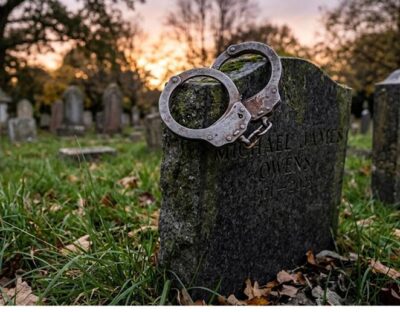

Alabama is known as the Bible Belt. In Alabama small towns, there are usually more churches than there are grocery stores. It is a way of life to be a member of a church family and spend your Sunday mornings singing the praises of glory. On most church house walls, there are the Ten Commandments. The 5th Commandment of God says, “Thou Shall Not Kill.” There is no fine print that says “except in the case of…”
Alabama is ranked 7th in the number of executions in the country and has a long history of racial violence and lynching before execution became legal. Alabama is one of two states that allow non-unanimous death sentences, where just 10 jurors out of 12 can impose the death penalty. In 2017, Alabama became the last state to end the practice of allowing judges to override a jury and sentence a person to death when the jury recommended life imprisonment. But the change was not retroactive.
Alabama has three methods of execution that include lethal injection, electrocution, and nitrogen gas. All have resulted in notable botches. The electric chair has caused flames to spark from the chair. The execution of Joe James by lethal injection holds the longest botched execution in the United States, lasting for three hours. In 2022, Alabama added nitrogen gas and was the first state to use it in the execution of Kenneth Smith in 2024. Witnesses to the nitrogen gas executions said that they saw Smith shake and writhe in pain and distress. Recently, in June 2026, the Eleventh Circuit Court of Appeals upheld a Federal District Court ruling that Alabama’s nitrogen gas execution violated the Eighth Amendment that prohibits cruel and unusual punishment.
How many innocent people are on death row whom we don’t even know about? Our legal system is not infallible. Innocent people go to jail. Unfortunately, we have dirty cops, paid-off judges, and prosecutors. The prosecutors who work in our District Attorney’s Offices have absolute prosecutorial immunity. This legal protection means that they cannot be sued in civil lawsuits for their actions, no matter how egregious the behavior.
Police corruption in Alabama is not just in the movies. The Grand Jury in Hanceville, a small town in North Alabama, determined that fifty-eight (58) felony criminal cases had been tainted by corruption in the Hanceville Police Department. Four police officers and the Chief of Police were indicted on charges related to mishandling or removing evidence from the evidence room.
Since 1973, there have been nine (9) Defendants in Alabama who have been exonerated after evidence proved they were wrongfully convicted. Several individuals currently remain on Alabama’s death row despite compelling facts that they are innocent. One of those men is Toforest Johnson, who has spent twenty-seven (27) years on death row for the 1995 murder of a deputy sheriff. There were ten (10) alibi witnesses placing him across town at the time of the crime. There was no physical evidence linking him to the crime. His conviction relied on a witness who was paid five thousand dollars ($5000) by the State for her false testimony that was concealed from Johnson’s defense attorney during the trial.
Rocky Myers is a Black man with a mental disability who has been on death row since 1993. No physical evidence connects him to the murder of his neighbor. The key witness later recanted their testimony, stating they were pressured by the police. The jury found him guilty and sentenced him to life in prison. The trial judge used the judicial override and sentenced Rocky to the death penalty.
Another big issue in Alabama is the fact that in many criminal cases, the Defendant is poor and cannot afford an attorney. The State will appoint the Defendant an attorney who is often inexperienced. The State pays the attorney a capped salary of One Thousand dollars ($1000) for out-of-court work based on twenty dollars ($20) per hour. Alabama is the only state that refuses to provide counsel to condemned prisoners, and they are forced to depend on volunteer lawyers.
In Alabama, the appeals process is complicated. After the trial and the Defendant is sentenced, they are entitled to an appeal that comes in three (3) tiers. The first is the Direct Appeal, which every Defendant who is sentenced to death will automatically have to appeal to the Alabama Court of Criminal Appeals, the Alabama Supreme Court, and the United States Supreme Court. The second tier is the State Post-Conviction Appeal that returns the case to the Circuit Court for a review. The trial court’s decision can then be appealed by the capital Defendant to the Alabama Court of Criminal Appeals, to the Alabama Supreme Court, and to the United States Supreme Court. These appeals, however, are not automatic. In the third tier, the capital case is then appealed to the Federal Courts. If, at any stage of the appeal, either the conviction or the sentence is reversed, a new trial or a resentencing may be required.
When researching this article, I was personally overwhelmed by the number of inmates who ended up on death row for lack of proper legal counsel. After twenty-six (26) years of being in the law profession, I immediately saw the countless chances that were available to some of these inmates that could have warranted a new trial. In the case of Andrew Lackey, a young man afflicted with a serious mental illness, the judge refused to order a competency evaluation and failed to inquire about the psychotropic medications that he was taking at the time of the offense and how they affected his mental state. They never asked what mental illness that Mr Lackey had been diagnosed with. He was executed in spite of the fact that no Federal Court had completed the appellate review to determine whether the trial was fair or the sentence was appropriate. So many of these cases are due to the lack of proper counsel who were inexperienced in defending a criminal murder case.
When we talk about “pro-life,” that does not only apply to the issue of abortion. The death penalty should be abolished not only because of the inhumane act of intentional violence, but also because the moral justification does not fit the Christian values of those who support the State having the legal right to play God and take someone’s life. There are too many flaws in the criminal justice system to one hundred percent (100%) guarantee that mistakes were not made, witnesses did not lie, prosecutors are honest, police departments did not make a mistake, judges are not biased, and that even governors lack the compassion to stop the execution.
Lynda Kirkpatrick