

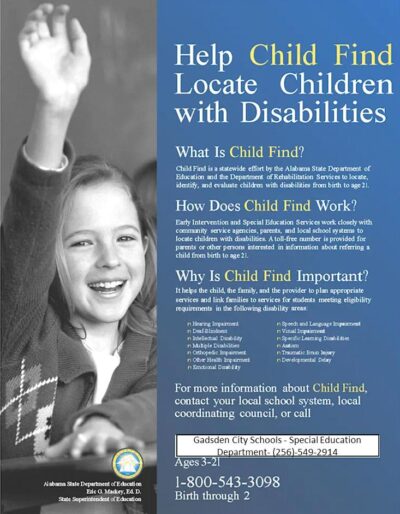
NOTICE
If you have a child with a suspected disability condition between the ages of 3–21
And live within the confines of the Gadsden City School System, please call the
Gadsden City Board, Special Education Department (256)549-2914. Testing is available
for children in the following areas:
Autism
Deaf-Blindness
Developmental Delay
Emotional Disability Hearing
Impairment Intellectual Disability
Specific Learning Disabilities
Orthopedic
Impairment Other Health
Impairment
Speech and Language Impairment
Traumatic Brain Injury
Visual Impairment
CHARACTERISTICS OF HANDICAPPING CONDITIONS
GADSDEN CITY SPECIAL EDUCATION DEPARTMENT
Please call the Gadsden City School’s special education department at
(256)549-2914 for further information.
SPECIAL EDUCATION SERVICES
1. AUTISM
Autism is a developmental disability that significantly affects verbal and nonverbal communication and social interaction, evident before age three, that adversely affects educational performance. This includes other pervasive developmental disorders. Other characteristics often associated with autism are engagement in repetitive activities and stereotyped movements, resistance to environmental change or changes in daily routines, and unusual responses to sensory experiences. The term does not apply to children who have an emotional disturbance as identified in Ala. Admin. Code r.290-8-9-.3(4)
2. DEAF-BLINDNESS
Deaf-Blindness means concomitant hearing and visual impairments, the combination of which causes such severe communication and other developmental and educational needs that cannot be accommodated in special education programs solely for children with hearing or visual impairments.
3. DEVELOPMENTAL DELAY
A child becomes eligible for this area of disability on his/her third birthday. Children who were identified with a developmental delay at age three, four, or five may continue to be identified with a developmental delay through age nine. Children identified with developmental delay must have a significant delay in one or more of the following areas:
1. adaptive development,
2. cognitive development,
3. communication development,
4. social or emotional development, and/or physical development, and needs special education services.
4. EMOTIONAL DISABILITY
Emotional Disability means a disability characterized by behavioral or emotional responses so different from those of the appropriate age, cultural, environmental, or ethnic norms that the educational performance is adversely affected. Educational performance includes academic and/or social/emotional skills. Such a disability is more than a temporary expected response to stressful events in the environment, is consistently exhibited in the educational environment, and persists despite individualized intervention within the general education and other settings. One or more of the following characteristics must be exhibited over a long period of time and to a marked degree that adversely affects educational performance:
1. an inability to learn that cannot be explained by intellectual, sensory, or health factors;
2. an inability to build or maintain satisfactory interpersonal relationships with peers and teachers;
3. inappropriate types of behavior or feelings under normal circumstances;
4. a general pervasive mood of unhappiness or depression; or 5. a tendency to develop physical symptoms or fears associated with personal or school problems.
Emotional Disability does not include socially maladjusted children unless they meet the criteria for emotional disability as defined in Ala. Admin. Coder. 290- 8-9.3(4)(a) 1. – 5., but does include children who are schizophrenic.
5. HEARING IMPAIRMENT
Hearing Impairment means: an impairment in hearing, whether permanent or fluctuating, that adversely affects a child’s educational performance. This term includes both deaf and hard-of-hearing.
6. INTELLECTUAL DISABILITY
Intellectual Disability means significantly sub-average general intellectual functioning existing concurrently with deficits in adaptive behavior and manifested during the developmental period that adversely affects the child’s educational performance. Students classified as having an Intellectual Disability must have a total or full-scale intelligence quotient of at least two standard deviations below the mean (usually 70 or below).
7. MULTIPLE DISABILITIES
Multiple Disabilities means concomitant impairments (such as mental retardation-blindness, mental retardation-orthopedic impairment, etc.), the combination of which causes such severe educational needs that they cannot be accommodated in special education programs solely for one of the impairments. The term does not include deaf-blindness. The child must meet all eligibility criteria for two or more areas of disabilities as defined in Ala. Admin. Code r.290-8-9-.3.
8. ORTHOPEDIC IMPAIRMENT
Orthopedic Impairment includes impairments caused by congenital abnormality (e.g., spina bifida), disease (e.g., poliomyelitis, bone tuberculosis), and impairments from other causes (e.g., fractures or burns that cause contractures, amputation, cerebral palsy). Having a medical diagnosis alone is not enough to justify being identified in the area of orthopedic impairment. The impairment must adversely affect educational performance.
9. OTHER HEALTH IMPAIRMENT
Other Health Impairment means limited strength, vitality or alertness, including a heightened alertness to environmental stimuli, that results in limited alertness with respect to the educational environment, that is due to chronic or acute health problems such as a heart condition, tuberculosis, rheumatic fever, nephritis, asthma, sickle cell anemia, hemophilia, epilepsy, lead poisoning, leukemia, attention deficit disorder, attention deficit hyperactivity disorder, or diabetes.
Having a medical diagnosis alone is not enough to justify being identified in the area of other health impairment. The impairment must adversely affect educational performance.
10. SPECIFIC LEARNING DISABILITIES
Refer to Ala. Admin. Code r.290-8-9-.12 for exceptions to this rule. Specific Learning Disabilities means a disorder in one or more of the basic psychological processes involved in understanding or in using language,spokenor written, that may manifest itself in an imperfect ability to listen, think, speak, read, write, spell, or to do mathematical calculations. Children with specific learning disabilities will demonstrate a severe discrepancy between intellectual ability and achievement in one or more of the following areas: basic reading skills, reading comprehension, mathematical calculation, mathematical reasoning, oral expression, listening comprehension, or written expression. No single criterion or specific number of characteristics can be used in identifying children with specific learning disabilities. Rather, the age-appropriateness of observed behaviors and the frequency, intensity, and duration of a child’s learning problems are critical in distinguishing specific learning disabilities from learning problems resulting from such factors as low motivation, underachievement, or inadequate instructions. Exclusion of Other Primary Conditions: The area of specific learning disabilities does not include children whose learning problems are primarily the result of visual, hearing, or motor impairments; mental retardation; emotional disturbance;
or environmental, cultural, or economic disadvantage.
11. SPEECH AND LANGUAGE IMPAIRMENT
Speech and Language Impairment means a communication disorder in the area of articulation, voice, fluency, or language that adversely affects a child’s educational performance.
12. TRAUMATIC BRAIN INJURY
Traumatic Brain Injury means an acquired injury to the brain caused by an external physical force, resulting in total or partial functional disability or psychosocial impairment or both, that adversely affects educational performance. The term applies to open or closed head injuries resulting in impairments in one or more areas such as cognition, language, memory, attention, reasoning, abstract thinking, judgment, problem-solving, sensory, perceptual, and motor abilities, psychosocial
behavior, physical functions, information processing, and speech. The term does not apply to brain injuries that are congenital or degenerative, or brain injuries induced by birth trauma.
13. VISUAL IMPAIRMENT
Visual impairment means a visual impairment that, even with correction, adversely affects a child’s educational performance. The term includes both partial sight and blindness.
Gadsden City Schools
Sharon Hall, Child Count Specialist
256-549-2914
Do you have a child with a suspected disability condition between the ages of 3-21 and live within the confines of the Gadsden City School system? Please call the Gadsden City Board of Education, Special Education Department at (256)549-2914. Testing is available for children in the following areas:
Autism
Deaf – Blindness
Developmental
Delay Emotional
Disability Hearing
Impairment
Intellectual
Disability
Specific Learning Disabilities
Orthopedic Impairment
Other Health Impairment
Speech and Language Impairment
Traumatic Brain Injury
Visual Impairment
2026 / 2027 Beginning of School Checklist
Notices to Private Schools
Service Plan (see private school folder) ____
Child Find _____
Notices to Media
Child Find_______
Notices to Physicians
Child Find _______
Notices to Specialized Services Organizations
Child Find _______
Notices to Juvenile Probation Judges
Child Find_______
Notices to schools
Child Find ______
Code of Student Conduct_____
The Gadsden Times _____
Gadsden City website_____
The Messenger ______